Tuesday, August 10, 2010

The Year Ahead in Higher Ed Technology

What happens when tough economic times combine with fatigue across the campus community hyping the latest “killer app,” and the growing intolerance of disruptions to services occasioned by security-related activities? I think the intersection of these three realities represent the most important challenges for campus information technology leaders in 2009.

We have not seen three years of negative economic growth since the birth of the Internet. We are one year into the global recession and the crystal-ball gazing under way on most campuses is not producing rosy scenarios. Chief information officers at most universities are closing in on “core” operations as they respond to cost cutting requirements after more than five years of marginal growth.

CIOs are portfolio managers. Like their counterparts, CIO portfolio management is really about meeting three goals: operating effectively, satisfying customers, and selectively engaging in innovation (R&D). In the sort of three-year downturn that most experts envision, tough decisions will be required to perform strongly in all three of those areas.

To read the full article click here:
Source: --Lev Gonick, Higher Ed Website

Tuesday, July 13, 2010

Lessons of a Summer Teaching Online

It was September of my first year as assistant professor at a liberal arts university when I read the announcement about teaching a summer online class. Summer seemed a long way off and the idea of the extra money I could earn was enticing. (My new baby, new mortgage, and the ever-lamented low pay of assistant professors weighed heavily on my mind.) As an avid user of Blackboard, I felt more than well-prepared for the task of teaching online and I thought it would be fun to challenge my teaching skills by depending entirely on the Internet to communicate class material to my students. Additionally, I was delighted to be able to teach students a seminar in my specialty area, cognitive neuroscience of memory. My university offered extensive course development and online training, including an assigned instructional designer for the entire process, so I fearlessly signed on for the adventure.

As I faithfully attended the monthly training meetings for Just in Time Technology (ex: how to use Skype) and for Course Design (ex: what is the conversion of 14 weeks pacing into a 30 day class), it began to dawn on me that I had underestimated the time and preparation required for my online course. I was one of a handful of new faculty who had added summer teaching to their first year obligations. As we sat in our classes and were shown the innovations of the online veterans, I doubt I was the only one who was feeling overwhelmed with bells and whistles. The online teaching veterans had planned every detail from music clips to the customized picture that would be shown behind the course title when students logged in. I learned that there are more than three ways to present a syllabus electronically, that I should probably post a video introduction of myself, and that the bar for creativity is set very high when an origami project can be successfully taught online. I had confidently thought I knew a lot about technology but I admit I had never considered such intricacies as whether presenting exam questions one-at-a-time or all on one page resulted in better student performance and ensured protection against cheating. As a cognitive neuroscientist, I know quite a bit about learning and memory but my mind was boggled by pedagogical concepts like “visual arguments” and “muddiest points,” and by the practice of making “concept maps” out of course material. As the summer crept closer and closer, I started to think that I had made a tremendous mistake.

To read the full article click here:
Source: --Amy Overman, Higher EdWebsite

Tuesday, June 22, 2010

Fixing Higher Ed

The press and the blogosphere have devoted significant coverage recently to a report by the Georgetown University Center on Education and the Workforce that predicted that the United States is on "collision course with the future." The report estimated that within a mere eight years, the nation will suffer a shortfall of at least 3 million workers with college degrees and 4.7 million workers with postsecondary certificates. The authors of the report concluded that to meet the challenges of a global economy in which 59 to 63 percent of domestic jobs require education beyond the high-school level, America’s colleges and universities "need to increase the number of degrees they confer by 10 percent annually, a tall order."

Although numerous commentators have responded to the report by echoing its call for increased access to higher education, it seems to me that few have focused on a key term in the report’s call to "develop reforms that result in both cost-efficient and high quality postsecondary education." Producing millions more baccalaureate-educated workers will do nothing to address the competitiveness of the U.S. workforce if those degrees are not high quality ones. Sadly, it is pretty clear that far too many college degrees aren’t worth the paper on which they are printed.

In 2006, the Spellings Commission reported disturbing data that more than 60 percent of college graduates were not proficient in prose, document, and quantitative literacy. In other words, significantly more than half of college degree holders in the United States lack the “critical thinking, writing and problem-solving skills needed in today’s workplaces.”


To read the full article click here:
Source: -- Henry F. Fradella,
Higher Ed Website

Wednesday, June 2, 2010

10 Social Media Tools For Learning

Do you have a training or information need that could benefit from a social media strategy? Understanding the universe of options can help you match your need to the best approach. So here are descriptions of ten applications representing different social media technologies that promote learning. Many of these tools and services are free or have a free trial period, which can encourage experimentation.

Each tool fulfills at least one of these criteria: encourages collaboration; enables user-generated content or input; provides a way to share; and facilitates informal or formal learning. Be sure to do additional research and comparison with similar products prior to making a selection as this is just a small sampling. (Listing is alphabetical.)


Audacity

Category: Podcasts

audacity

Although podcasts are a one-way form of communication, they enable the creation of user-generated content. Podcasts are fairly easy for anyone to make and with the free downloadable software, Audacity, it becomes an inexpensive option. Podcasts are a great medium for distributing an organization’s content and expertise because they can be played on hand held devices and computers.

Users can record and edit audio with Audacity and it runs on most operating systems, including Mac OS X and Windows. Key features include recording through a microphone or mixer, digitizing recordings from tapes, audio editing, importing and exporting audio files, effects and quality adjustments. For details on how to create a podcast, see How to Create Your Own Podcast on About.com.

To read the full article click here:
Source: --The eLearning Coach Website

Thursday, May 13, 2010

Re-Energizing Students' Motivation

INTRODUCTION: I teach transfer as well as developmental level English courses. I’ve been most disturbed by the attrition rate of both my under-prepared and bright students. Half way through one recent semester of my Developmental English class (pre-Comp I), I noticed the original energy of the students was slipping, absences were increasing, and more homework was coming in late. So I needed an activity that would give these students a chance to re-energize themselves for the “last lap.” I developed an assignment that would give my students an opportunity to delve deep into what could motivate them to continue working hard and achieve success. Although I used this activity in a composition course, variations of it (such as a letter or journal entry) could be used in any course where the instructor is seeing students’ motivation and efforts flagging. I suggest using it between the sixth week and mid-semester.

PURPOSE:
  • To re-energize student motivation to achieve an academic goal
  • To help students discover their own personal steps to achieve an academic goal
  • To inspire more responsible student behavior and class participation
SUPPLIES/SET UP:
  • Handout A: “Steps to Achieve a Goal” (appended below)
  • Chalk and chalkboard to note rough outline or essay “plan” suggestions
  • Pen and paper to begin the essay (or appropriate supplies if teaching in a computer lab)
  • Colored paper half sheets for a “New Changes” Reminder/Bookmark (optional)
  • Handout B: “Initial Feedback” (appended below)
  • Handout C: “End-of-Semester Feedback” (appended below)
DIRECTIONS:

1. Explain that midterm is the time of the semester when many students lose sight of their academic goals, lose motivation, and stop taking actions necessary for college success. Offer specific examples from behaviors of past students. Suggest to students that now would be a good time for them to take a look at a key goal they have for college this semester, reminding themselves of their personal motivation for succeeding.

2. Distribute Handout A: “Steps to Achieve a Goal.” Have students fill in the blanks.

3. Distribute the colored half sheets and then, based on question # 7 of Handout A (Steps), have students complete a “New Changes Reminder/Bookmark” that they can keep in their textbook or post at home for frequent review.

To read the full article click here:
Source: --Regina Popper, On Course Website

Monday, April 26, 2010

The Research Log

INTRODUCTION:

I have taught college composition for almost 20 years. The second half of the composition sequence includes a major research project I call simply the Term Paper. Students receive the assignment in the opening weeks of the term and submit their finished papers immediately before final exams. In my earliest years of assigning the Term Paper, I collected final papers that were routinely poorly focused, poorly developed, and poorly organized. The more serious problem represented in these products was that student writers were not learning and adopting effective habits for research and writing. My regular weekly reminders seemed to have little effect. What I eventually decided on was a regular series of assessments that would motivate the students more directly than reminders and classroom activities. I called it the Research Log: a series of brief weekly research/writing assignments related to the Term Paper. This strategy can be adapted to nearly any class that includes a major research project, provided that the time for working on the project extends over a period of at least a few weeks.

PURPOSE:

  • Show writers how to work steadily on an extended project.
  • Encourage broad (many types of sources) and deep (sources with intense focus) research strategies.
  • Reinforce critical thinking and writing.

SUPPLIES/SET UP:

This is a semester-long series of short assessments. The following documents are appended at the end of this article, but instructors may wish to adapt any of these to suit a specific learning goal or assessment:

  • The Term Paper assignment handout
  • Description of the Research Log
  • Ten assignments for individual Research Log entries
  • Rubric for assessing individual Research Log entries
  • Research Log Survey (post-Term Paper deadline)
To read the full article click here:
Source: --Douglas Okey, On Course Website

Tuesday, April 13, 2010

10 Rules For Writing Multiple Choice Questions

This is a back-to-basics article about the undervalued and little-discussed multiple choice question. It’s not as exciting as discussing 3D virtual learning environments, but it might be just as important. If you need to use tests, then you want to reduce the errors that occur from poorly written items.

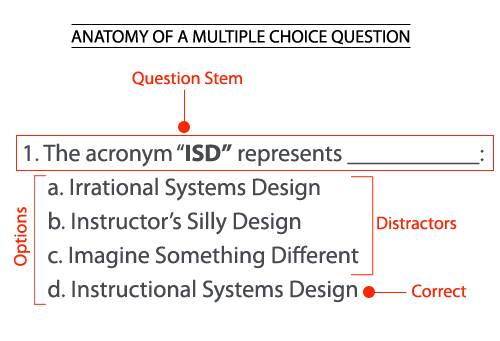
The rules covered here make tests more accurate, so the questions are interpreted as intended and the answer options are clear and without hints. Just in case you’re not familiar with multiple choice terminology, it’s explained in the visual below.


Here are the ten rules. If you have any others, please add them through the Comments form below.

Rule #1: Test knowledge comprehension, not just recall

Multiple choice questions are criticized for testing the superficial recall of knowledge. You can go beyond this by asking learners to interpret facts, evaluate situations, explain cause and effect, make inferences, and predict results.

Rule #2: Use simple sentence structure and precise wording

Write test questions in a simple structure that is easy to understand. And try to be as accurate as possible in your word choices. Words can have many meanings depending on colloquial usage and context.

Rule #3: Place most of the words in the question stem

If you’re using a question stem, rather than an entire question, ensure that most of the words are in the stem. This way, the answer options can be short, making them less confusing and more legible.

To read the full article click here:
Source: --The eLearing Coach